Role: Product Designer
Length of Project: 7 weeks
Client: ExSitu
Background
Passionate about enhancing user experiences and empowering individuals through thoughtful design, I collaborated with ExSitu, an innovative aged care program provider, during my tenure at Harness Projects. This project focused on elevating the user experience for care organizations and their clients, with a specific emphasis on the facilitators who work directly with mature aged individuals.
ExSitu, a cloud-based aged care program, partners with individuals and care organizations to deliver personalized care experiences, prioritizing the empowerment of mature aged individuals in their decision-making processes. The foundation of ExSitu lies in addressing a gap in the industry, ensuring the preservation of individual values in care practices.
What sets ExSitu apart in the aged care sector is its commitment to prioritizing individual values, exemplified through the meticulous attention given to the “card sorting” procedure. This procedure plays a pivotal role in assisting mature aged individuals in making crucial decisions about their care, free from external influences.
The primary focus of this project is to enhance the user experience for care organization clients, specifically the facilitators—nurses who play a direct role in the well-being of mature aged individuals. Recognizing the significance of card sorting, this aspect has been seamlessly integrated into the design solution to ensure a user-centric approach.
The project’s scope is centered on improving the user experience for facilitators, acknowledging their vital role in the care ecosystem. Additionally, some exploration has been conducted to identify potential solutions for managers who collaborate with these facilitators in assisting our end users. The project landscape holds ample potential for further development and innovative ideas.
Integrating research findings into design
The design solution seamlessly incorporates a wealth of research and materials graciously provided by ExSitu, including user personas, dashboard screenshots, a summary of user roles, and a system demo. This collaborative approach, combined with insights gathered through a comprehensive interview with ExSitu’s founder, guided the development of a user-centric and effective product.
- Card Sorting Integration:
- Recognizing the significance of card sorting as a distinguishing feature for ExSitu, it became evident that this needed to be a central element in the new design.
- The solution prioritizes the seamless integration of card sorting to ensure a user experience aligned with ExSitu’s unique value proposition.
- Addressing Tech Support Challenges:
- An observation emerged from both the research and the interview: a majority of facilitators struggled with new software, often resorting to seeking tech support.
- In response, the design proposes a multi-faceted solution—a readily accessible help page and an interactive training platform embedded in the dashboard. This approach not only aids tech-poor facilitators but also minimizes the human resources ExSitu expends on addressing tech-related queries.
- Enhancing Accessibility for Users with Poor Vision:
- Insights revealed a significant number of facilitators grappling with poor vision.
- To address this, the design adopts a user-friendly approach—employing strong color contrast and a minimum 24-size font.
- The prototype, meticulously crafted within the dimensions of an iPad Pro 11″, ensures optimal legibility on small devices, a practical choice given its prevalence as a likely work companion for facilitators.
- Streamlining Information Access:
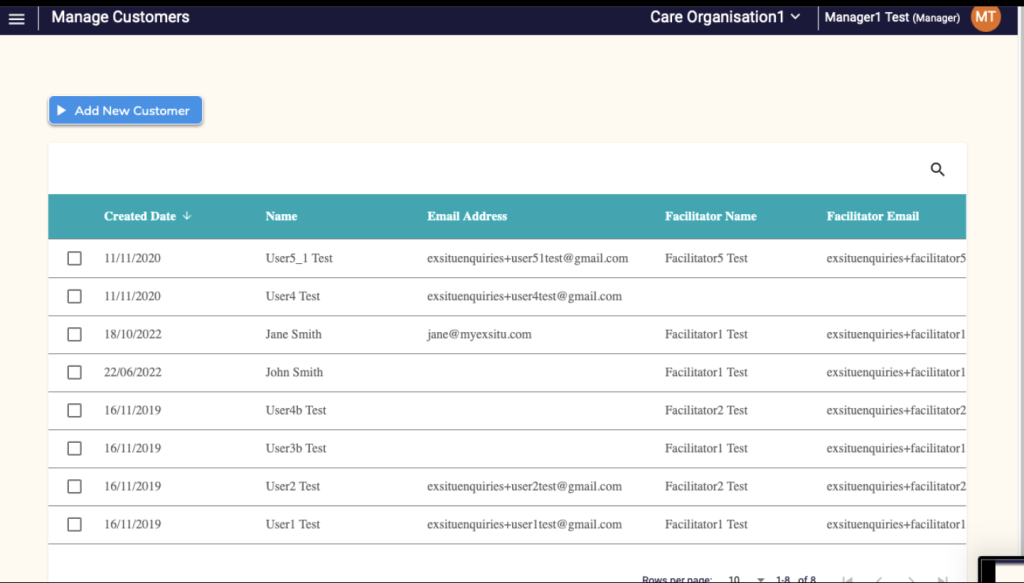
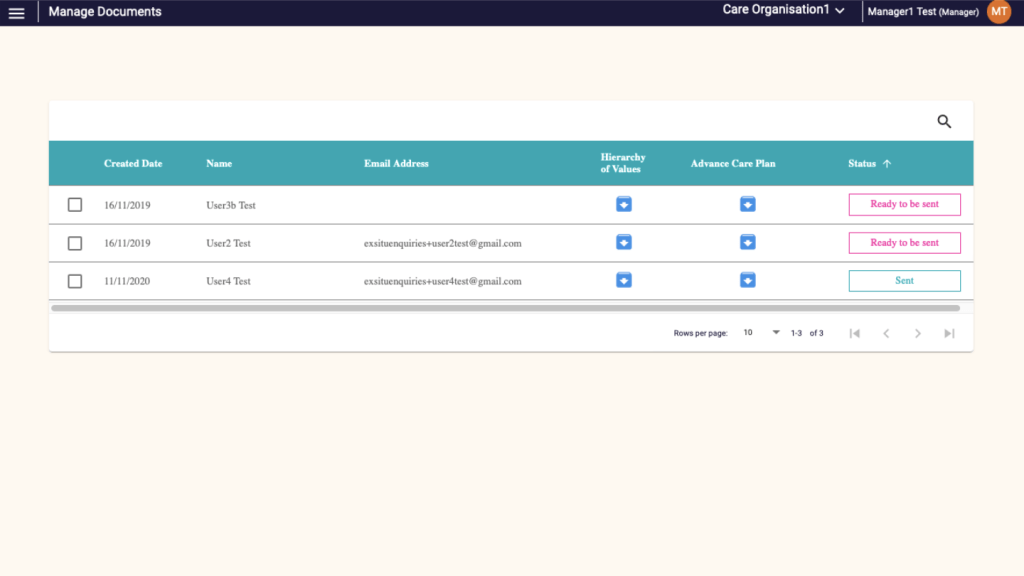
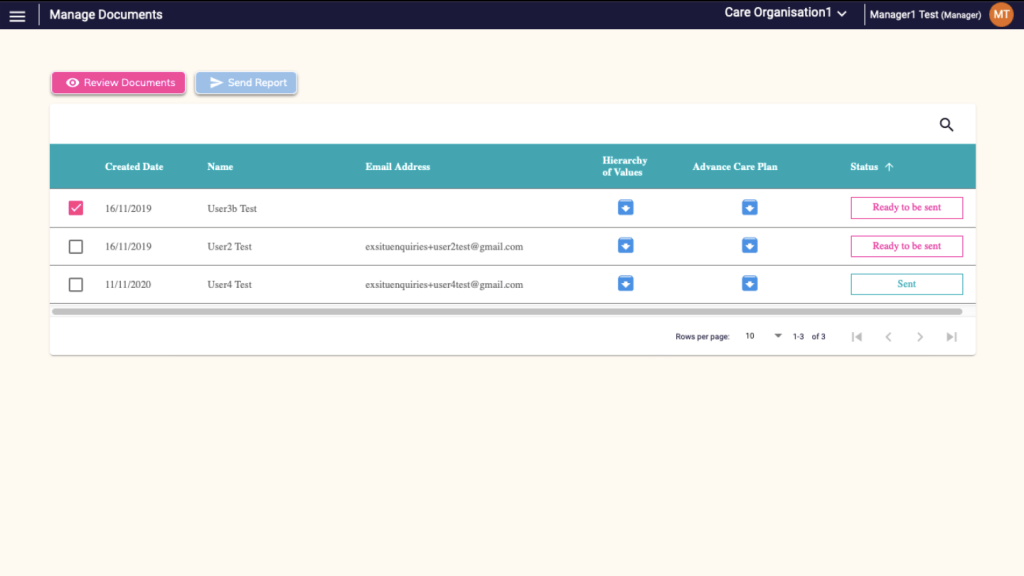
- As seen from the pictures above, user frustration stemming from the lack of a cohesive link between the list of customers and their respective documents informed the solution.
- Aiming for a more intuitive interface, the design ensures users can seamlessly access client information and documents in one consolidated location, enhancing overall system efficiency.
- Navigational Support for Time-Poor Facilitators:
- Acknowledging the time constraints and navigational concerns expressed by facilitators, the design introduces a comprehensive solution.
- Beyond a training platform, the inclusion of a to-do list provides a practical tool for time-poor facilitators, aiding them in managing tasks efficiently and reducing unnecessary stress.
This integrative approach, marrying research findings with hands-on insights from ExSitu, positions the design to not only meet but exceed the specific needs and challenges faced by facilitators and end users within the aged care program.
Prototype
Taking into account everything required for the design solution, this is the prototype I came up with. I utilised ExSitu’s brand colours into the UI of the design. Due to limited time, there were some items that have yet to be perfected on.
Usability Testing: Enchancing User Experience
In our pursuit of a user-centric design for ExSitu, a targeted usability test was conducted, recognizing the constraints of time and resources. While recommending further testing for a comprehensive evaluation, this single test proved instrumental in gaining valuable insights that steered subsequent developments in the initial design.
Methodology
Adopting a guerrilla testing approach, we engaged a user falling within our target age group, mirroring the characteristics of our intended audience, particularly in terms of tech literacy.
Tasks assigned to the user, without explicit navigation guidance, included:
- Create a new client
- Check documents for the new client
- Review care plans for the new client
- Identify pending tasks
- Complete the most urgent task
The user was introduced to the dashboard page at the onset, simulating the experience of logging in.
Observations and Insights
Observing the user’s interaction with the design illuminated the most natural pathways and highlighted areas necessitating adjustments. Additionally, direct inquiries delved into the user’s thought processes, shedding light on design strengths and areas requiring refinement.
Positive Design Aspects:
- To-Do List Effectiveness:
- The incorporation of a to-do list emerged as a standout feature, simplifying task prioritization and providing clarity on the user’s impending actions.
- Intuitive Learning Portal:
- The learning portal preview showcased a self-explanatory component, facilitating seamless user understanding of its functionality.
- User-Friendly Navigation:
- Navigational elements, such as finding help, returning to the previous page, and expanding pop-ups, were adorned with familiar icons and strategically positioned for ease of use.
- Accessibility Improvements:
- Expandable pop-ups and large font sizes addressed potential accessibility concerns, particularly for users with poor vision.
Areas for Refinement:
- Enhancing To-Do List Accessibility:
- While the to-do list was praised for its effectiveness, there was an identified need to make listed tasks more easily accessible, enhancing the overall user experience.
Conclusion:
Despite the singular nature of this guerrilla usability test, its impact has been substantial, shaping the ongoing development of the ExSitu design. As we advocate for additional testing to comprehensively validate our design choices, the insights gained have catalyzed positive improvements and positioned the product to better serve the needs of our intended audience—individuals navigating the complexities of aged care with both simplicity and efficiency.
Post-Usability Testing Considerations and Redesign
In the aftermath of rigorous usability testing, a deeper exploration into the user expectations surrounding each dashboard function led to crucial insights and potential refinements in the current design.
In the existing layout, the ‘To-Do List,’ ‘Card Sorting,’ and ‘My Client’ pages share a similar table setup. While the ‘My Client’ page effectively displays all clients under the facilitator’s purview, the ‘To-Do List’ and ‘Card Sorting’ pages exclusively showcase relevant clients with outstanding tasks and card sorting activities, respectively.
A pivotal question arose regarding the apparent redundancy of a standalone ‘Card Sorting’ page, given its similarities to the ‘To-Do List.’ Contemplating potential enhancements, an intriguing possibility emerged—transforming the ‘Card Sorting’ page into a distinct tab under the client pop-up. However, upon thorough consideration, the decision was made to preserve the ‘Card Sorting’ page in its original form, opting instead to refine the ‘To-Do List’ for the following reasons:
- Preserving Essential Features:
- Card sorting stands as a distinctive and essential feature of ExSitu, contributing significantly to the program’s differentiation in a competitive landscape. Its connection to empowering mature aged individuals in decision-making aligns seamlessly with ExSitu’s core values.
- Holistic Facilitator Duties:
- Recognizing that a facilitator’s responsibilities extend beyond administrative tasks, encompassing various in-person care activities, solidified the decision to retain the dedicated ‘Card Sorting’ page.
New Concept for To-Do List: Organisational Tool
Introducing a transformative concept for the ‘To-Do List’—evolving it into a comprehensive Organisational Tool. This refined tool not only addresses administrative items but also incorporates a daily schedule. This shift necessitates resource rostering within the managerial department to ensure seamless integration.
Key Features:
- Drag-and-Drop Functionality:
- To enhance user experience and flexibility, tasks that don’t require specific timing can be effortlessly organized using a drag-and-drop feature. This ensures ease of use and a dynamic scheduling approach.
Prototype Development:
Acknowledging time constraints, a preliminary paper prototype has been crafted to visualize and conceptualize the envisioned Organisational Tool, paving the way for future development and refinement.
This forward-thinking redesign aims not only to optimize the user experience but also to align with the broader responsibilities of facilitators, presenting a holistic solution that integrates essential features and addresses the nuanced needs of both users and the ExSitu program.
Conclusion: Transforming Aged Care User Experience
Embarking on the journey with ExSitu, a dynamic aged care program provider, has been a compelling exploration in enhancing user experiences within the realm of aged care. Throughout my tenure at Harness Projects, this collaborative project delved into the intricacies of the ExSitu platform, seeking to amplify its impact on both facilitators and mature aged individuals.
My commitment to user-centric design was fortified through comprehensive research, collaboration with ExSitu, and a meticulous usability testing process. The integration of existing research, interviews with ExSitu’s founder, and guerrilla testing allowed for a holistic understanding of user needs and program intricacies.
Key design solutions were conceived, addressing significant pain points identified in the existing system. From streamlining card sorting processes to enhancing accessibility for tech-poor facilitators with poor vision, each decision was guided by a strategic blend of research insights and user-centric principles.
The usability testing phase, though limited in scope, was instrumental in validating design choices and uncovering nuances that would further refine the user experience. Observing a user within the target age group, reflective of my intended audience, provided invaluable feedback, especially considering their tech-poor profile—a characteristic shared with our primary user base.
Post-testing considerations led to a thoughtful reevaluation of the dashboard functions, particularly the preservation of the essential ‘Card Sorting’ feature and the innovative transformation of the ‘To-Do List’ into a comprehensive Organisational Tool. This forward-thinking redesign not only adheres to ExSitu’s unique value propositions but also addresses the diverse and nuanced responsibilities of facilitators, envisioning a future where administrative tasks seamlessly integrate with the broader spectrum of caregiving duties.
In conclusion, this project stands as a testament to the power of user-centric design, where research-driven insights and thoughtful considerations culminate in a solution that not only addresses current challenges but envisions a future where aged care is not just streamlined but also empowering and empathetic. As I present this portfolio to prospective employers, it is with the confidence that this project exemplifies my dedication to creating meaningful, impactful user experiences that resonate with both users and the core values of the organizations I collaborate with.
 Vanessa Chow Designs